Alberta Totz says a year before she and her attorney husband Andy started dating they began seeing each other “in very random places, very often.”
“I knew him growing up but hadn’t seen him in years. Then all of a sudden he was everywhere.” At the car-repair shop, at a baby shower in Austin, at a party they’d both been dragged to by friends. “Some force was putting us in each other’s paths,” she says. “I believe in magic.”
Alberta calls it magic, but what are these coincidences and serendipities that happen as we go about our everyday lives? Are they flukes, coincidences without meaning? Or are they fate, driven by a force we can’t see?
Steve Jobs, in his 2005 commencement address at Stanford University, said, “You can’t connect the dots looking forward; you can only connect them looking backwards. So you have to trust that the dots will somehow connect in your future.”
But the “dots” can seem breathtakingly mysterious – almost eerie – as they happen. Psychologist Carl Jung called these events “synchronicities,” or events that seem to connect without logical cause.
“Practically speaking, we use the term ‘synchronicity’ to refer to meaningful experiences of coincidence,” says Sean Fitzpatrick, director of educational services at The Jung Center, which offers classes in psychology, life and expressive arts, all relating to the philosophies of Carl Jung and designed to help people learn to navigate life in healthy ways.
Stories of what Jung called “synchronicity” abound.
On the morning of September 11, 2001, as Lagenia Clark was flying with her 9-month-old twin boys from Louisville to Houston, she befriended a grandmother flying her 11-month-old granddaughter Mallory on the same route.
When they landed for a layover in Birmingham, they were told to exit the plane with everything they had – the flight was grounded. The grandmother, who had family in Birmingham, stayed there but brought Lagenia diapers to get her through her long drive home to Houston in a rental car. When Lagenia got home, she wrote the story down, including the details about their new friend Mallory, so her boys would one day know their connection to 9/11. Then she put the story away.
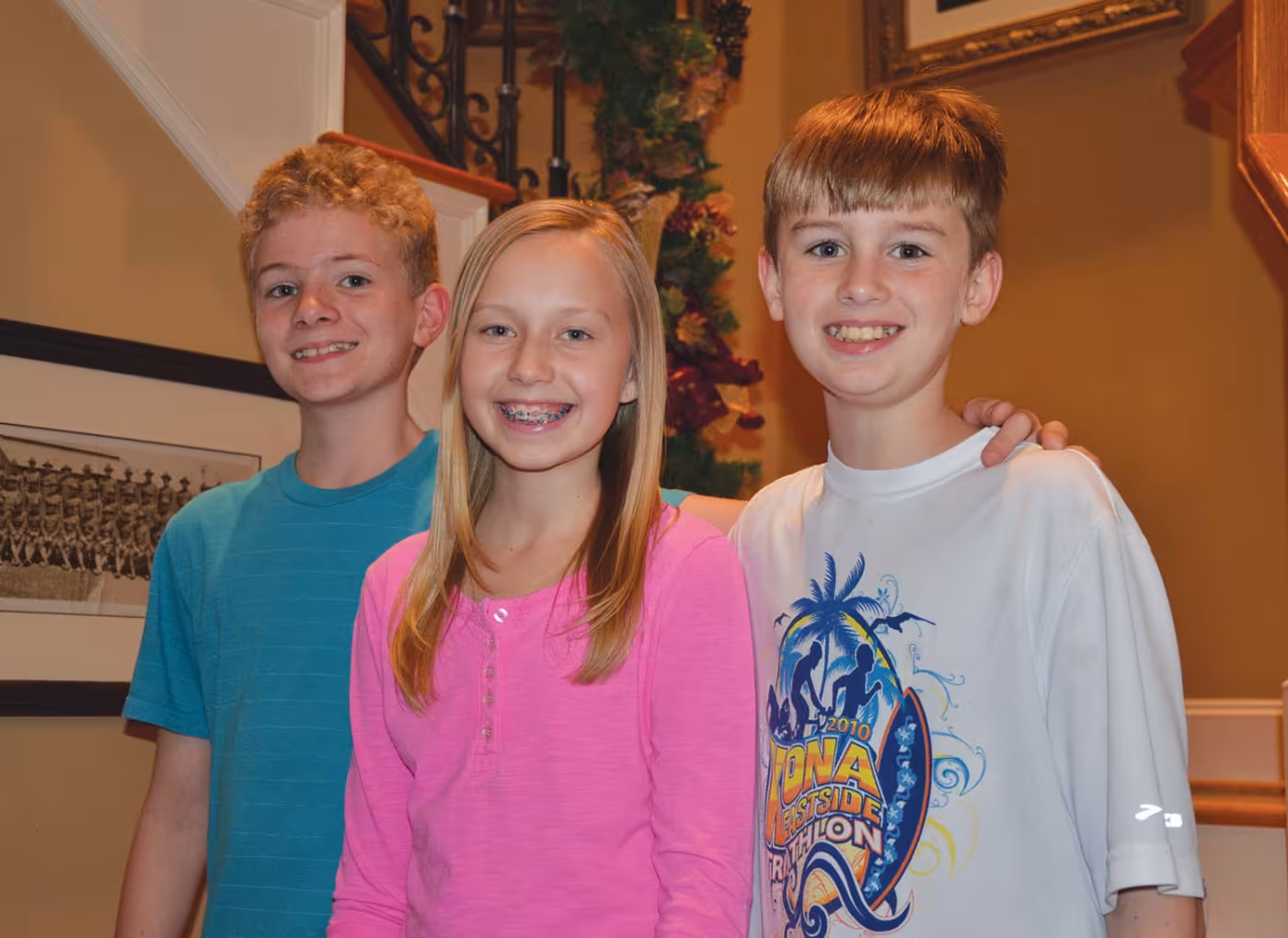
Seven years later, Lagenia went on a scrapbooking retreat with friends she had known for several years. Talk somehow came around to where everyone was on 9/11, and Lagenia told her story. One friend, Julie Jenkins, whose daughter Mallory was friends with Lagenia’s boys, already knew Lagenia’s story. Stunned, she said, “That was my mother-in-law, and the baby was Mallory.” Mallory and the Clark twins, along with their moms Lagenia and Julie, had been friends for years by that time. But until that moment, no one realized that they all shared the same 9/11 story.
Another example: When Nicole Gibson gave birth to her second baby, her husband George gave her a sapphire and diamond bracelet. Nicole lost the bracelet and was devastated. A year later, in carpool line with the car window open, Nicole was flipping through her wallet. The wind caught a receipt and blew it into a crevice next to her seat. Reaching down to grab the paper, she saw a sparkle – the bracelet.
“The serendipity was that just after carpool, I was driving to the dealership to trade my car in,” Nicole says. “If the wind hadn’t blown that receipt right then, I never would have found the bracelet!”
“A moment of synchronicity does not mean anything specific,” says The Jung Center’s Fitzpatrick. “What it does is call us to pay attention. Events in our inner world are connected to the external world in ways we cannot explain. But we can learn from them.”
Fate or fluke, synchronicities – or serendipities or coincidences – can serve as both prompts for pause in life’s routine (think Nicole, carpool and the bracelet) and as guideposts inviting us to attend to our intuition (think Alberta and her soon-to-be husband).
“I believe serendipitous events are moments of grace; they appear and act as ways to guide us,” says Elizabeth Irvine, author of A Moment’s Peace: A Mom’s Guide to Creating Calm Amidst Chaos.
“The more we pay attention, the more the signs appear,” Elizabeth says. “Just notice these little things, and say, ‘Thank you.’”