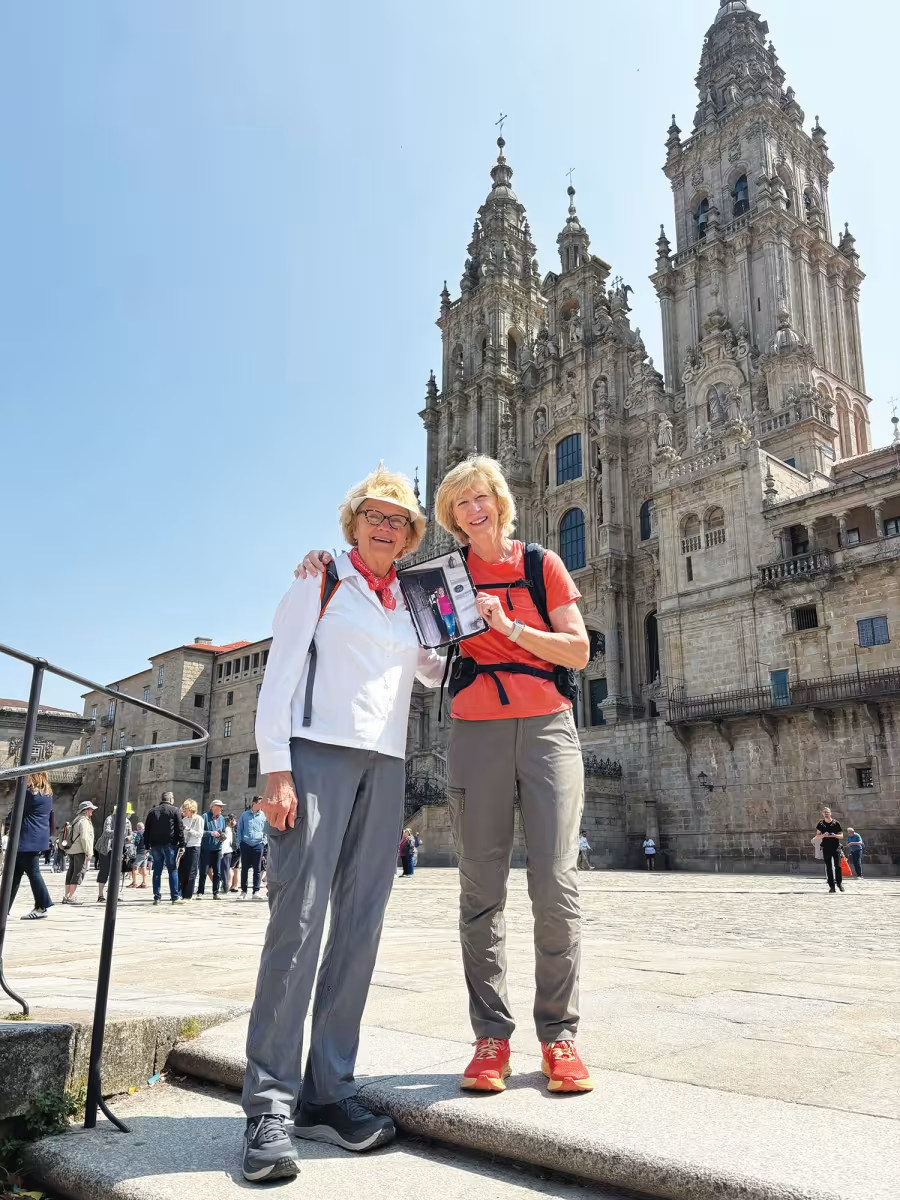
On a quiet stretch of trail in northwestern Spain, the Camino de Santiago has a way of meeting people exactly where they are.
The Camino de Santiago – often shortened to “the Camino” – is a centuries-old network of pilgrimage routes that cross Europe and converge in Santiago de Compostela, in northwestern Spain. Walked for more than a thousand years, the Camino has deep roots in Christian tradition as a journey honoring St. James, though today many people walk it for spiritual reflection, personal challenge, or simply the experience of moving slowly through historic landscapes. Routes begin in multiple countries, including France and Portugal, and vary widely in length, terrain, and intensity.
For schoolteacher Susan Tallman, walking the Camino was a return – to a path she had once walked alone, carrying big questions and learning how to trust herself step by step. Susan had walked the Camino once before, spending 12 days on a route along the northern coast of Spain. This trip followed a different path, beginning along the southern coast of Portugal before continuing into Spain over eight days, with the only shared point being the final arrival in Santiago.
For Susan’s friend Kim Jacobson, the journey marked a very different kind of beginning.
It was a first – a leap into uncertainty, undertaken after retiring from a 40-year career as a corporate attorney.
The two had been friends for decades. But walking together on the Portuguese Camino, alongside a small group of women, revealed new dimensions of both the trail – and each other.
“It seemed like a great challenge and a new, exciting adventure,” Kim recalled. “And I was so thrilled, but…about two weeks in, that’s when I got really anxious.”

The group pauses at an 18th-century Baroque sanctuary in A Escravitude, where they stopped for lunch along the route; Susan Tallman is wearing a visor, and Kim Jacobson is at far right.
Kim had committed quickly when the invitation came, but her mind soon began to race ahead of her feet. “I tend to overthink and over prepare and try to control the details to ensure success,” she said. “So I dove into every bit of information I could find about the Camino and what it takes to get ready.”
She joined Camino Facebook groups, talked to people in Houston who had walked it before, and followed a detailed training plan. “I had a whole list of things that could go wrong in my head,” she said. “So let me try to control that.”
Training meant long walks through Houston’s heat – “It’s hot. It’s flat. You’re roasting on concrete” – often in full hiking gear, backpack and all. “I got a lot of really strange looks in the meantime,” she laughed.
Susan, by contrast, didn’t hesitate when the opportunity arose to return to the Camino after six or seven years. Her first journey had been solo and intentional, a time of deep inward reflection.
“The first one was an awesome experience,” she said. “And I think I really felt that the whole time because I knew I had to be resourceful and be in charge and plan my next step.”
This time would be different. The walk was organized through Spanish Steps, with luggage transfers, guides, and carefully chosen accommodations. “There was nothing that was on my mind other than just walking the Camino,” Susan said. “And I was pretty secure in that.”

The women walk together on a rainy day, the trail remaining beautiful even despite the weather.
The route itself – the Portuguese Camino – was chosen for its accessibility and beauty. While the journey briefly dipped into Portugal at the start, most of the walking unfolded across northern Spain.
“It was much more level,” Susan said. “It was not as strenuous.” The group would walk just over 100 kilometers, enough to earn their Compostela certificates – the official certificate awarded to pilgrims who complete the Camino de Santiago pilgrimage to Santiago de Compostela, Spain, proving they've walked or cycled the final 100km – without the intensity of longer routes.
For Kim, footwear became the turning point. Early training brought unexpected aches – shin splints, heel pain – and doubts resurfaced. “That’s what made me think, ‘Oh my gosh,’” she said. “Can I do this?”
Once she found the right shoes – “the new Altra Experience Wild trail runners…bright orange” – everything shifted. “Once I got the right shoes… I felt like I was going to be just fine.”
When the walking began, the Camino unfolded gently. “The first day, I think we did eight miles,” Kim said. “It wasn’t too bad.”
By the third day, something clicked. “Your body was just in a rhythm,” she said. “From that point on… I wasn’t exhausted.”
Susan recognized the feeling immediately. “This is what your body’s built to do,” the guides reminded them. Walk. Rest. Repeat.
Days took on a simple, grounding pattern – morning starts, café stops, conversations that deepened mile by mile. Kim had expected to crave solitude. Instead, she found herself drawn into connection.
“One of the biggest surprises for me is that this group of women was such an interesting dynamic group of people,” she said. “We just had the richest, most authentic conversations.”
The group included pastors, counselors, therapists – women accustomed to listening deeply. “It just opened up space to really talk about things that mattered,” Kim said.

The group stands on the trail between Pontevedra and Barosa, with Susan at far left and Kim at far right.
Susan felt the contrast keenly. “The first time, solitude was with me all the time,” she said. “And the second, I didn’t have any of that.”
Instead, the emotional texture was lighter. “The group setting was fun. It was lighthearted. It was entertaining,” she said. “We had a lot of social times.”
That didn’t mean there was no room for reflection. “Kim and I both decided we’d have individual rooms,” Susan said. “That was really nice… It gave me time to journal.”
The landscape itself offered moments of quiet awe. Kim was captivated by the details. “If you look at my pictures, clearly it’s the hydrangeas that caught my eye most often,” she said. “They were enormous.”
Susan agreed. “Hydrangeas that are taller than I am, and I’m six feet tall,” she said. “They were just breathtaking beauty.”
They walked along old Roman roads, through villages and forest paths, sometimes near the coast. “You would see these old markers or old stones in the road,” Kim said, “and you think back about all the people that had walked over them…for centuries.”
Not every moment was serene. Rainy days tested resolve. But those, too, became memorable. One evening, after walking in cold rain, the group arrived at an especially beautiful place.
“It was like a wedding venue kind of place,” Kim said. “And Susan and I went out and covered the grounds and just took a bazillion pictures.”
For Susan, a moment in a small town stood out vividly. “We came around just a street corner…and there was a symphony playing in the courtyard,” she said. “It brings tears to my voice just thinking about it.”
The Camino’s spiritual dimension surfaced differently for each of them. Kim noticed the energy of fellow pilgrims. “You hear the stories,” she said. “There’s a spirit in the Camino… It’s just a really good energy there.”
Susan felt her faith nourished through community. “The women that I was with did that this time,” she said. “Their sharing of their faith and their life experiences.”
When they reached Santiago, emotions diverged again. Susan felt the weight of arrival. Kim felt the loss of the journey’s continuity. “I hated it that we were so close to the end,” she said. “I wanted the conversations to keep going.”
In the weeks after returning home, the Camino continued to work on Kim in subtle ways. “What else am I holding myself back from?” she asked herself.
Susan recognized the distinction between her two Caminos. “The first one was really big, life-changing stuff,” she said. “And the second one was more subtle… but very positive.”
Neither woman emerged unchanged. And neither ruled out returning.
“You start thinking,” Kim said, “I might like to do that again. And I’d like to go a little bit further next time.”
On the Camino, it seems, the walking rarely ends where the trail does.
Editor’s note: Read about Susan Tallman’s first journey on the Camino in Solo trek leads to letting go, Jan. 2018, by Tracy L. Barnett.