Our marriage was kind of arranged,” says Cihan Duran, a radiologist who moved to the United States from Turkey with her husband and three children in 2010. “I was in medical school and Ahmet was doing his business. His family talked to my family, and my parents told me a handsome man would come to visit me.” Cihan giggles a bit when she recounts the memory.
“He came to the hospital, and we went to dinner, and we were engaged in one week.” A year later, Cihan and Ahmet were married. That was 37 years ago.
Cihan says the arrangement was a blessing. “I was so busy,” she says, “studying all the time. This was a good alternative. And he was a good-looking guy. And it worked!” Cihan and Ahmet’s three children are now grown: their son Alper, a radiologist, lives in Miami and is married to a Turkish woman who is a dentist; their younger daughter Munevver is finishing medical school in Dallas and is applying to a radiology residency; and their older daughter is in her fourth year of a psychiatry residency at UC Davis in Sacramento.
That daughter – the psychiatrist – is Elif, and in April, she will marry Chris Amadi, merging her own Turkish background with his Nigerian traditions. “This is the first international marriage for our family,” Cihan says.
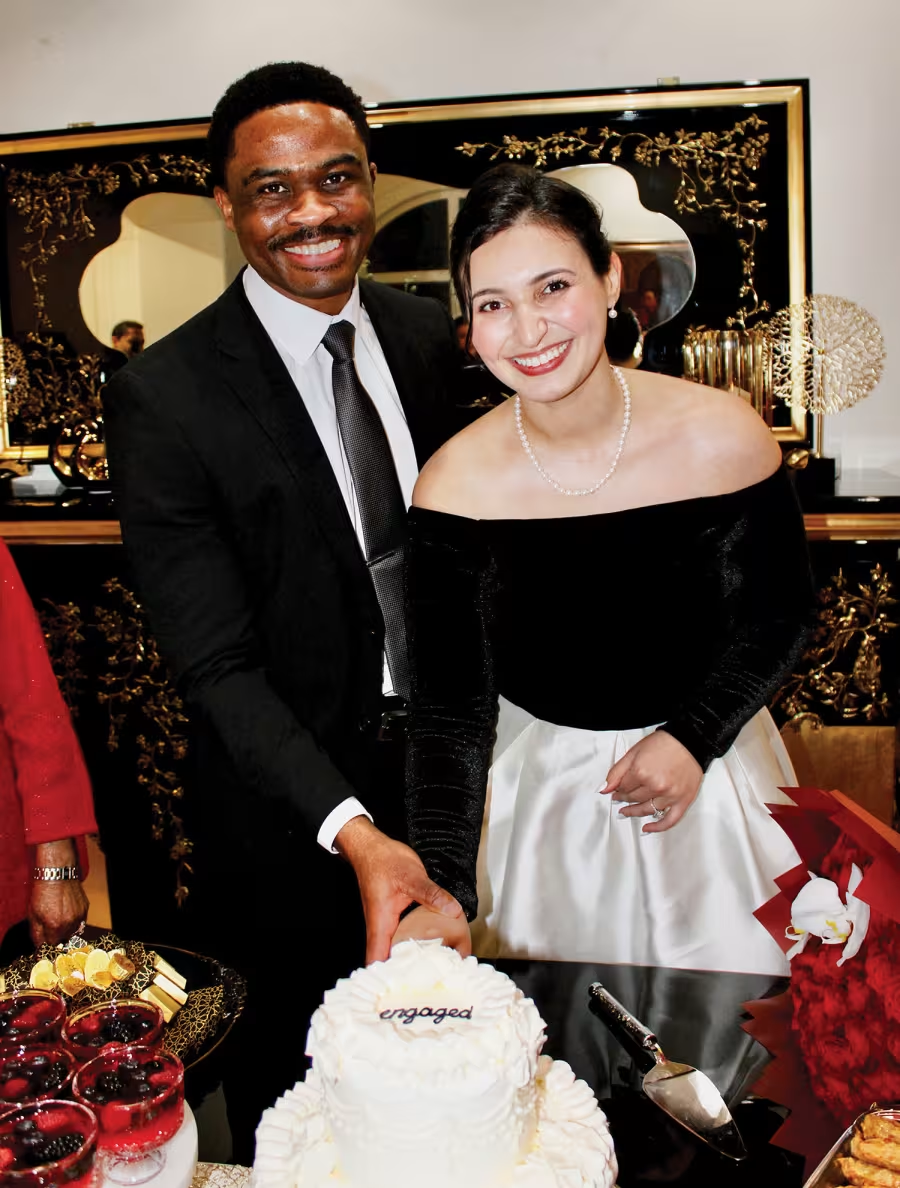
Unlike her parents, Elif and Chris met organically during their respective residencies in psychiatry and pharmacy at UC Davis. Chris has since gone on to become a pharmacy manager at Stanford University in Palo Alto, about two hours away from Sacramento. Instead of one week, like her parents, the younger couple spent three years dating. Their first date was actually a Thanksgiving dinner together in Sacramento. “Neither of us had family in town or Thanksgiving plans,” Elif says. Their second date was a study date, and in July 2025, Chris proposed. On Nov. 8, he and Elif became “officially” engaged in a traditional Turkish ceremony in Houston.
“In the United States, when the groom proposed to the bride, this is engagement,” Cihan says in her charming Turkish accent. “But in our country, we do a separate engagement ceremony that brings the families together. For Elif, we made this ceremony at our home.”

Cihan Duran (left) and her husband Ahmet Duran (right) hosted a Turkish kız isteme to celebrate their daughter Elif Duran's engagement to Chris Amadi.
Cihan and Ahmet had already met Chris in Sacramento. “I love him,” Cihan says. “He is a hardworking, responsible, mature man.” She already calls him her son-in-law. But the families hadn’t met until the engagement ceremony in Houston.
“There were some nerves about everyone coming together,” Elif says, “but I know my parents and I know his parents, and they are all lovely people. Mostly, I was worried about the language barriers. Everybody has accents.” Chris’ family, like Elif’s, immigrated to the United States when he was a teenager.
With that, the families were set to convene from across the country to honor the Durans’ Turkish and the Amadis’ Nigerian traditions: Elif from Sacramento; Chris from San Jose; Elif’s brother and his family from Miami; Elif’s sister from New York; and Chris’ family from Kansas City. “It should have been a straightforward gathering,” Cihan says. But a government shutdown caused airport delays and cancellations. “I had everyone’s flight info open on my phone all day on Friday, and I was checking it obsessively, you could say.”
Thankfully – and surprisingly – everyone arrived safely and on time. “Our stress melted and was replaced by laughter, warm embraces, and the joyful merging of Turkish and Nigerian customs,” Cihan says. “They are lovely people,” she says of Chris’ family. Elif adds, “It all came together beautifully.”
“In Turkish culture,” Cihan explains, “the engagement ceremony begins with a symbolic ritual called kız isteme.” The ceremony is traditionally arranged by the groom’s family: They will visit the bride’s family, and the eldest male in the groom’s family will ask for the bride’s hand in marriage. The moment is said to bond the two families when the bride’s family accepts the offer. Similarly, in Nigerian tradition, the groom’s family approaches the bride’s and asks for her hand.

In a twist on the Turkish tradition that sees a bride-to-be salting her fiance's coffee, Elif spiked Chris' coffee with honey.
But in Turkey, Cihan says, “the bride-to-be prepares a special cup of Turkish coffee for the groom. But this coffee carries a twist – literally.” According to custom, the bride adds salt instead of sugar to the coffee. If the groom drinks the entire cup without flinching, he is believed to be patient, loving, and truly committed to the marriage. “It is a test for the groom,” Cihan says. “If he really wants the bride, he will drink this salty coffee.”
She goes on to explain that, historically, in arranged marriages, the bride-to-be would secretly add salt to the groom’s coffee if she wanted to tell him, without embarrassing him, that she did not want the marriage. “It was a nice way of letting him down instead of saying I don’t want to marry this guy and running away,” Elif says. With time, the custom changed into the current practice, which is much more playful.
In yet another twist, Elif couldn’t bear to make her fiancé drink salty coffee. So she added sugar and honey instead. Cihan laughs, “Chris was expecting a salty coffee.” In reality, he knew better. “He doesn’t even drink coffee,” Elif says. “So the week before, I told him not to worry, I got you.”
Ironically, Elif and Chris followed more in her maternal grandparents’ footsteps than in her parents’. “My mother and father were high school sweethearts,” Cihan says of her mother, 84, and her father, who has passed away. “That was forbidden at that time; the culture was very strict about boy-girl relationships.” Having met when her mother was a high school freshman and her father was a junior, the two waited for each other for six years – through high school and university – to marry. Still, the tradition of the kız isteme was upheld by the family. Both Elif’s parents and grandparents participated in their own kız isteme ceremonies when they were preparing to marry years ago.
Cihan considers Elif and Chris’ love story a testament to Houston’s diversity and openness.
“When I came from Boston [where the family lived for one year] to Houston, I was like Oh, this looks like my home,” Cihan says, noting that she did four consecutive fellowships at MD Anderson Cancer Center. “It was such a diverse population. Everybody had their own accent. I didn’t feel like an outlier.” The Durans have enjoyed participating in Houston’s large Turkish community.
“We love this city. I have lovely neighbors, like a sister to me. And there is every kind of cuisine you can find.”

At the kız isteme, engagement rings were tied to a ribbon that was then cut, signifying the bond of marriage.
Speaking of cuisine, Cihan explains the difference between Turkish coffee and American coffee. “It is very strong, and served in a small cup like espresso,” she says. “And there are grounds of the coffee at the bottom of the cup.” In Turkey, there are coffee fortune tellers, who “read” the grounds at the bottom of the cup after the cup has become cold. Are they for real? “No,” Cihan laughs. “But for some in Turkey, this is a profession.”
Of course, Houston has plenty of opportunities to order a Turkish coffee. In Rice Village alone, Cihan recommends Sambal Chef and Pasha Turkish Restaurant.
Currently, Elif says she’s focused on planning the wedding, which will take place in San Jose in April. “My brother got married in Turkey,” she says, “and everything was very straightforward. They went to a nice hotel and got all the vendors through the venue, all in one day. But in the United States, you have to piece it all together one by one. I’m just figuring out how to throw a large-scale party for the first time ever.” Once married, Elif and Chris will spend one year apart. He will continue on at Stanford and she will embark on a one-year fellowship at the University of California San Francisco.
“Marriage is tough even if you are from the same background, you are speaking the same language, you have the same religion,” Cihan says. “But if my daughter got married to a Turkish man, I would still have anxiety. When your kids get married, you’re always anxious. I have found that there are lots of similarities between the Nigerian and Turkish cultures. We are all very family-oriented, we have close bonds. My prayers are with them.”
“I’m really excited,” Elif says of merging Turkish and Nigerian traditions as she and Chris create a family of their own. “I’m going to visit Nigeria for the first time in February, and then we will have a traditional wedding there in June. We are just figuring out how our lives will come together.” If the kız isteme is any indicator, they will come together very sweetly.
Editor’s note: Read more about the Duran family and Turkish culture and traditions in Ties that Bind: A family matriarch’s legacy of love by Cathy Gordon, March 2025.