 People Finder

Christmas Traditions Around the World
How do you celebrate?

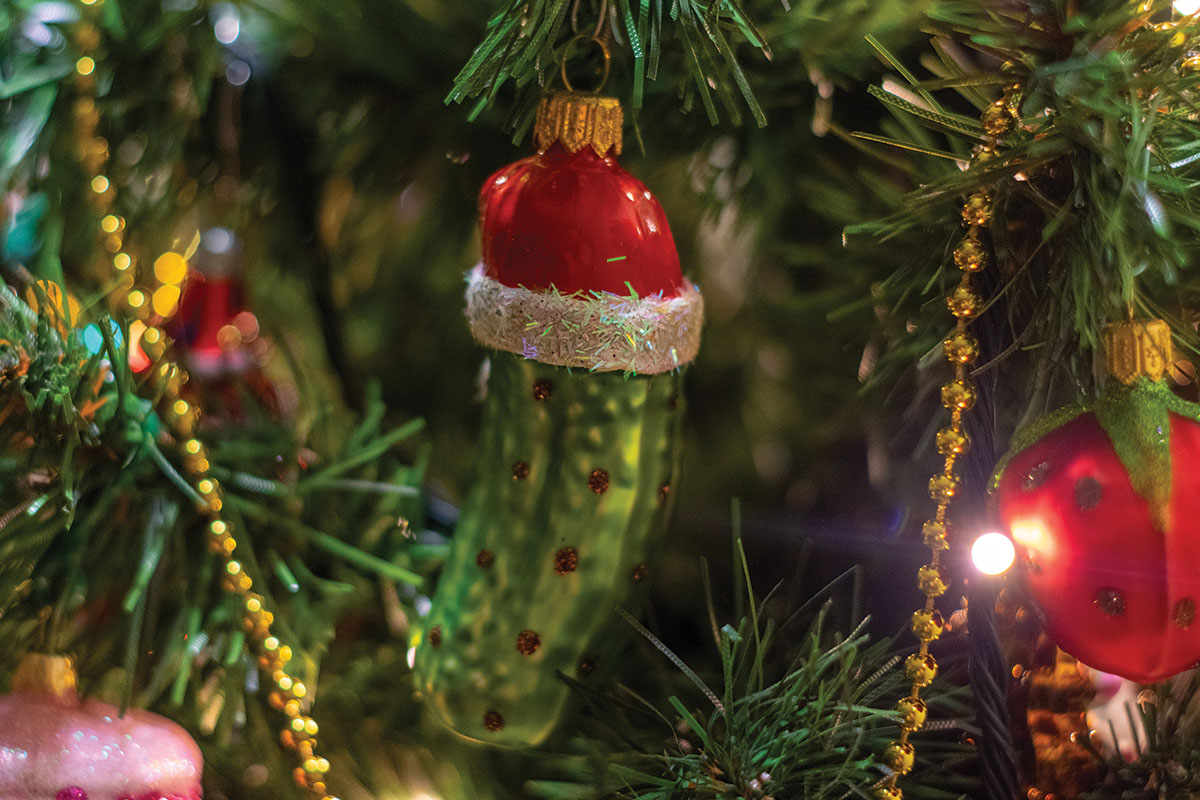
TRADITION, TRADITION Are you in a pickle over Christmas? (Photo: www.istockphoto.com/portfolio/Lukasz-Jasionowski)
I’m Jewish, so my family did not celebrate Christmas, but I grew up with one Jewish “Christmas tradition”: eating at a Chinese restaurant on Christmas Eve. Actually, this tradition dates back to the late 19th century due to Chinese restaurants being one of the few businesses open on Christmas. Now that tradition looks like it has become a multi-faith event. Last Christmas Eve, my wife and I went to dine at our favorite Chinese place only to find several Christian families dining there, too. So much for my one unique Jewish Christmas practice. But if Christmas is your holiday, it looks like there are many ways to celebrate besides consuming Chinese cuisine.
I’m aware that most folk on Christmas exchange gifts, go to church, decorate their houses with lights, sing carols, and set up real or artificial Christmas trees. But who would have thought that at this time of the year you should lock up your brooms in a closet? That’s what you do in Norway. On Christmas Eve, the belief is that evil witches roam the night, so you don’t want them to have access to your brooms to fly wherever they might want in order to do their mischief. But then how do you clean up spilled popcorn?
I had heard that Germans practice a custom of hiding a pickle ornament on the Christmas tree. The one who finds it gets a gift or is rewarded with good fortune in the coming year. (Turns out, upon Googling it, it’s actually thought to be a German-American tradition created in the late 19th century.) Wherever the tradition originated, why a pickle? Why not?
In 1974 in Japan, Kentucky Fried Chicken (KFC) offered a package meal “Kentucky for Christmas!” Even though Christmas in no holiday in Japan, it was a hit. To this day, the tradition of having KFC on Christmas Eve persists there. Maybe fried chicken on Christmas Eve this year instead of Chinese.
American kids hang stockings over the fireplace so that Santa can leave “stocking stuffers.” Kids in other countries prefer leaving shoes, at least for St. Nicholas Day (Dec. 6). The children in the Netherlands place their shoes by the fireplace stuffed with carrots or hay for the horse that accompanies Sinterklaas. Santa Claus then obligingly leaves candy or other treats in the shoes. I wonder if a child with big feet gets more stuff than a tiny footed one. In Iceland, the custom is that a badly behaved child gets a rotten potato in his shoe instead of a treat. Who wants stinky Christmas feet?
If you find yourself in Caracas, Venezuela, on Christmas morning, watch out for those going to Christmas Mass on roller skates. The custom, known as las patinatas navideñas, is so well observed that major streets are closed off for the skaters. What does that have to do with Christmas? Probably the same thing as a pickle on your Christmas tree.
And while we are talking of Christmas trees, if you are in New Zealand, forget the evergreen trees. There, a native tree, Pohutukawa, is used. It is a tree with bright crimson flowers. Branches are cut to decorate for the holiday. I wonder if they bother with poinsettias.
Our neighbors to the south in Mexico celebrate Christmas by setting up nacimientos (artful, detailed nativity scenes), starting Dec. 16. These have finely crafted figures placed carefully in the display. On Christmas Eve, Baby Jesus is added, but you have to wait until Jan. 5, Twelfth Night, before the three Kings may be added.
I particularly like the Icelandic custom of exchanging books on Christmas Eve. Then you pass the evening reading by a fire and snacking on sweet treats. That’s my idea of a religious experience.
In Finland, you start Christmas morning with a bowl of rice porridge seasoned with cinnamon and butter or milk. One bowl will have an almond hidden in it, and whoever gets the lucky almond will have good fortune. But in Slovakia, they are a bit friskier. On Christmas, the traditional dish is loksa pudding. It is made with milk, bread, and poppy seeds. The oldest family member flings it at the ceiling. The more that sticks, the more luck the family will have.
On Christmas Eve, Polish families share a religious wafer called oplatek before dinner. But you can’t start the meal until the first star appears. There’s always an extra place setting for a possible unexpected guest to go along with the season’s spirit of hospitality.
An ancient Swedish Christmas tradition is the Yule Goat. It dates to the 11th century when a large goat figure was supposed to protect against evil spirits. In the 17th century, people would dress as goats and play tricks. Alas, it has evolved now into only a Christmas decoration.
I guess I’m a little envious of my Christian friends. This time of year, we Jews do light Hanukkah candles, play dreidel, eat potato pancakes and jelly donuts, and maybe exchange gifts. That’s it. So I kind of wish I had a special pudding to throw at the ceiling or that I could roller skate to KFC for a Hanukkah treat.
Editor's note: Read more about the St. Nicholas Day boot tradition in this 2021 Buzz feature.
Want more buzz like this? Sign up for our Morning Buzz emails.
To leave a comment, please log in or create an account with The Buzz Magazines, Disqus, Facebook, or Twitter. Or you may post as a guest.
